


The lymphatic system includes a network of lymphatic vessels and the lymphoid organs (lymph nodules, lymph nodes, spleen, and thymus), which are distributed throughout the body and linked by a network of vessels (Figure 1).

1. Lymphatic vessels
Lymphatic vessels contain and transport a fluid known as lymph, which is collected in the tissues and organs of the body and released into the large veins. Small-diameter lymphatic vessels, or lymphatic capillaries, are mainly found in the loose connective tissue of the dermis and in the intestinal mucosa. These ducts are sealed at one end, whereas the other fuses with other capillaries to form larger vessels, known as lymphatic vessels. In turn, lymphatic vessels join with one another and form larger vessels. Finally, the largest lymphatic vessels release the lymph into the large veins located in the neck, between the jugular and subclavian veins.
Lymphatic capillaries are made up of endothelium and a discontinuous basal lamina that makes possible a higher permeability than in most blood capillaries. Therefore, lymphatic capillaries are very efficient at gathering fluid from tissues. This fluid becomes lymph, which is a solution containing ions and proteins. In the lymphatic nodes, the lymph components meet the cells of the immune system.
Lymphatic vessels contain layers of connective tissue and smooth muscle cells, which become more developed as the diameter gets larger. Like veins, these vessels have valves to prevent lymph from flowing backward. The movement of the lymph through the vessels is not driven by the heart. Instead, it is propelled by the movements of the body and its internal organs, meaning the lymph is driven forward by the muscles of the body.
2. Lymph nodules
In the lamina propria of the intestine, urogenital tracts, and respiratory tracts, there are aggregates of lymphatic tissue, largely consisting of lymphocytes organized around lymphatic vessels and not limited by a connective capsule. These formations are known as lymph nodules (or lymphatic follicles; Figure 2). They are distributed throughout the body and altogether form the so-called diffuse lymphatic tissue. Lymph nodules are found in key locations of the body to be the first defenders against pathogens, so they play a role in the early immune system response. Lymphocytes and eosinophils are abundant in lymph nodules. The reticular connective tissue, made up of reticular cells and fibers, forms the stroma of lymph nodules.
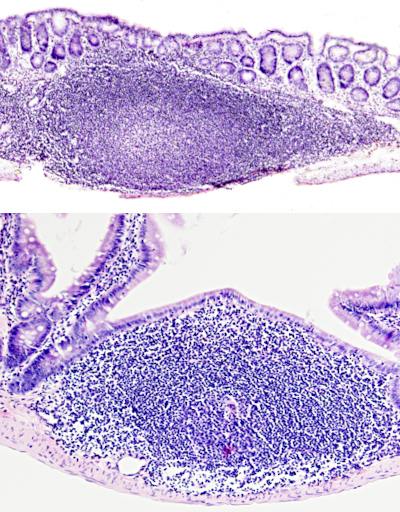
Structurally, lymph nodules are composed of a germinative center where lymphocytes proliferate and differentiate into plasma cells to synthesize and release antibodies. Actually, the presence of a germinative center means that an immune response is in progress. Surrounding the germinative center, there is a peripheral zone known as the mantle, or corona (cap), populated by smaller lymphocytes.
In the human intestine, there are about 12700 to 18500 lymph nodules, more abundant in the rectal segment and less in the colon. In addition to those located in the mucosa, lymph nodules are frequent in the appendix, tonsils, and Peyer's patches of the intestine ileum. In the course of chronic inflammatory processes, new nodules can be formed, known as secondary lymph nodules, as a response of the immune system. For instance, lymph nodules are not found in the stomach mucosa, yet pathologies like gastritis may lead to the formation of nodules in this organ.
In mice, the so-called lymphoid follicles develop in the intestine during the first week after birth. They are generated by the association of innate immune cells that express the RORgamma-t transcription factor. This factor is involved in the induction of lymphoid tissue. Subsequently, B lymphocytes are recruited, leading to the formation of the lymphatic nodule. This process is under the influence of molecular signals released by the gut microbiota. Lymphocytes of the innate immune system gathered at the lymphatic nodule express the AhR receptor, which is able to detect molecules resulting from digestion and other molecules coming from the external environment. This recognition may favor the development of lymphatic nodules.
3. Lymph nodes
Lymphatic nodes are kidney-like structures covered by a layer of connective tissue, known as the capsule. They are found along the path of lymphatic vessels, between tissues and large veins. The size of lymphatic nodes ranges from a few millimeters to two centimeters. They are abundant in the axilla, inguinal region, and mesenteries (see Figure 1).
Lymphatic nodes contain connective and reticular tissues organized in supporting structures (Figures 3 and 4). The external capsule consists of dense connective tissue that extends projections into the interior of the node. These projections are known as trabeculae, and they form the main support framework of the lymphatic node. Internally, the reticular connective tissue, containing cells and reticular fibers, holds the node tissues. Trabeculae and reticular tissue maintain the structural organization of the node and support the lymphatic cells. On the surface of the node, there is the hilum, where the efferent lymphatic vessel comes out of the node and blood vessels enter and exit the node.
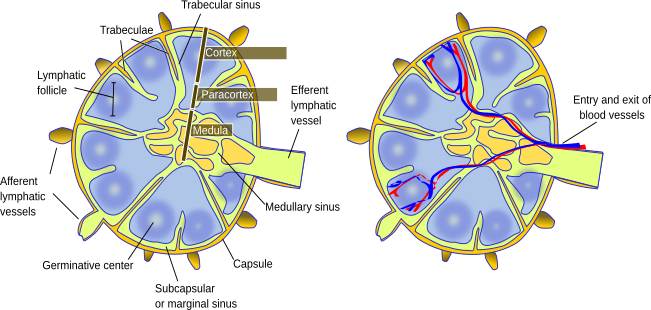
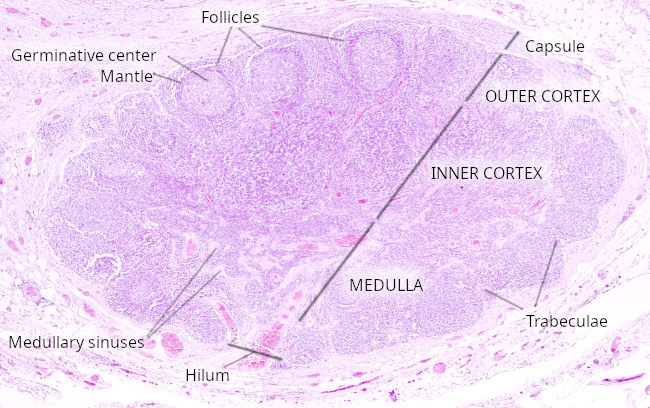
The lymph node is divided into a cortex and a medulla. The cortex consists of an outer cortex and an inner cortex. In the outer cortex, B lymphocytes are organized into nodules or follicles, which can be either primary follicles (containing a germinative center) or secondary follicles (lacking a germinative center). The inner cortex is rich in T helper lymphocytes.
The central part of the lymph node is known as the medulla. It contains lymphatic tissue organized in the so-called medullary cords, which are separated from each other by the medullary sinuses. There is also a supporting scaffold of reticular tissue. Lymphatic tissue is mainly composed of lymphocytes, macrophages, and plasma cells.
Lymph filtration occurs as lymph goes through ducts and sinuses in lymphatic nodes. First, lymph enters the lymphatic node, crossing the capsule through the subcapsular, marginal, and cortical sinuses. From here, lymph is gathered by the trabecular sinuses and subsequently by the medullary sinuses. The endothelium of these sinuses is discontinuous in the areas where it is in contact with lymphatic tissue. From the medullary sinuses, lymph is collected into the efferent lymphatic vessel that exits the lymphatic node through the hilum.
Lymph nodes are major places for phagocytosis and where the first steps of the immune response occur. Lymph transports migrant dendritic cells to lymph nodes. These cells, together with resident dendritic cells located in the follicles of the node cortex, can initiate an immune response. They are antigen-presenting cells that induce the activation of B lymphocytes in the transition zone between the cortex and medulla. Activated lymphocytes migrate to primary nodules and proliferate to form the germinative centers, so primary follicles become secondary follicles. These lymphocytes differentiate into memory B lymphocytes and plasma cells. Then, both move to the medullary region of the node. Later, most of the memory B lymphocytes exit the lymphatic node and colonize other secondary lymphatic organs to produce clones. About 90 % of plasma cells also leave the lymphatic nodes and go to the bone marrow to produce antibodies.
4. Thymus
The thymus is a bilobed organ found above the heart and before the large blood vessels. It develops from the pharynx endoderm. The main function of the thymus is done during the period between birth and puberty, serving as a site for maturation of T lymphocytes. After puberty, the thymus lymphatic tissue is replaced by adipose tissue.
The thymus is covered by a capsule of connective tissue. In some parts, this layer sends inward walls of tissue, dividing the organ into uncompleted compartments known as lobes. Thymus lobes are composed of parenchyma that can be divided into two regions: cortex and medulla. Cortical parenchyma contains many developing T lymphocytes, also known as thymocytes, macrophages, and epithelial-reticular cells. Within the medulla, there are T lymphocytes as well, although they are more loosely distributed. The medulla appears more clear after general staining.
Blood vessels enter the thymus through trabeculae. These vessels are surrounded by a layer of connective tissue. T lymphocytes do not interact with the blood directly due to a barrier called the blood-thymus barrier, made up of endothelium, macrophages, and epithelial-reticular cells.
5. Spleen
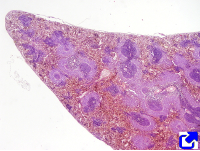
The largest lymphatic organ is the spleen. It performs hematopoietic and immune functions. The spleen is heavily irrigated by the blood system and carries out mechanical and immune filtration. It contains many lymphocytes, macrophages, and reticular cells (which form a kind of net), as well as non-cellular spaces and vascular ducts.

The spleen is wrapped by a capsule of dense connective tissue that extends trabeculae into the interior of the organ. This connective tissue contains myofibroblasts that have the ability to contract. The spleen can store large amounts of erythrocytes, which are released again into the main vessels by the contractions of myofibroblasts.
The spleen pulp, or spleen parenchyma, is the inner part of the organ that is not connective tissue. There are two types of pulp: white and red. The white pulp contains many lymphocytes arranged around the central artery, forming a sheath known as the periarterial lymphatic sheath (PALS). The red pulp contains many erythrocytes and vein sinuses.
-
Bibliography ↷
-
Langman JM, Rowland R. 1986. The number and distribution of lymphoid follicles in the human large intestine. Journal of anatomy. 149:189-94.
-
 Cardiovascular