

Plant tissues. Meristems
CORK CAMBIUM or PHELLOGEN
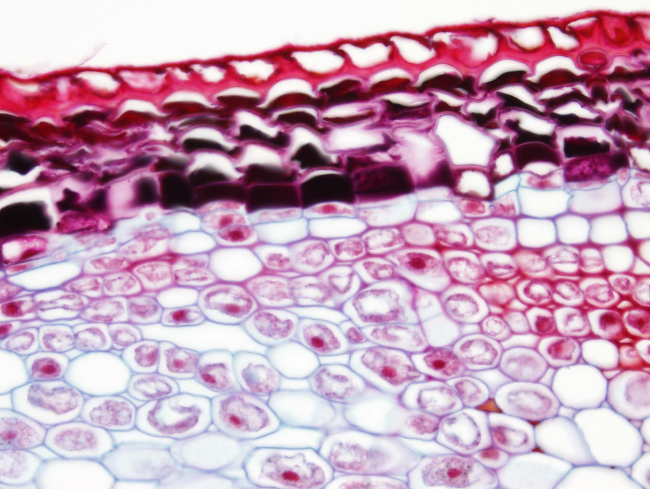
Species: elderberry (Sambucus spp).
Technique: paraffin section stained with safranin /Alcian blue.
Cells of the cork cambium, or phellogen, show the typical features of meristematic cells, although they may contain functional chloroplasts. It arises after the secondary xylem and phloem formation is started, although the vascular cambium and cork cambium may be occasionally formed at the same time. The first meristematic cells may develop after differentiation of parenchyma or collenchyma cells, from primary phloem, or even from the epidermis. The cork cambium begins as a cylinder or as several segments that get fused aftewards The first cork cambium usually lasts for one year. However, depending on the plant species, it may last for several years (for instance, more than 20 years in apple trees) or during all the lifespan, as in the oak (Quercus ruber). Every year, sometimes after several years, a new cork cambium originates in deeper regions of the stem from parenchymatic cells of the secondary phloem. In the roots, cork cambium arise from the pericycle. Cork cambium usually shows a seasonal activity.
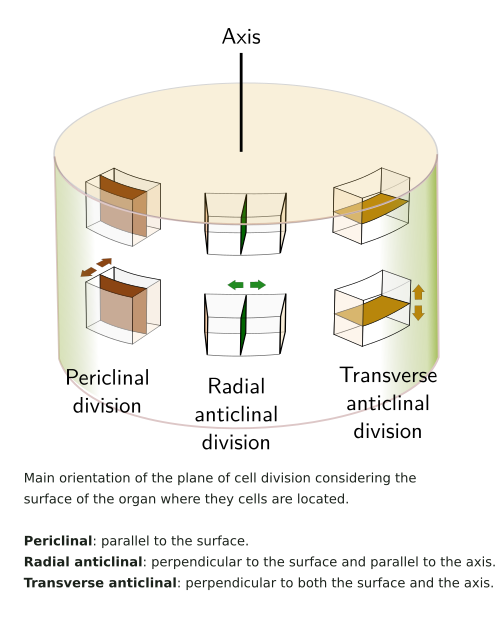
Cork meristematic cells are elongated and form a continuous cylinder in the cortex or are arranged in strands or plates at different depths from the surface. These cells undergo periclinal divisions (they divide in planes that are parallel to the surface of the organ; see figure) and give rise to phellem, commonly known as cork, outward and phelloderm inward. It is of note that the pattern of gene expression observed in the vascular cambium resembles that seen in de development of the cork cambium. The three components, phellem (cork), phellogen (cork cambium), and phelloderm, constitute the periderm, a protective tissue that replaces the epidermis in stems and roots, expanding their diameter when secondary growth occurs. The cork cambium produces more cork layers than phelloderm layers. Since phelloderm tipically shows seasonal activity, dead cork of the outer layers detaches from the surface annually. The outer bark containing dead cork, and sometimes some phloem, is known as a rhytidome.