


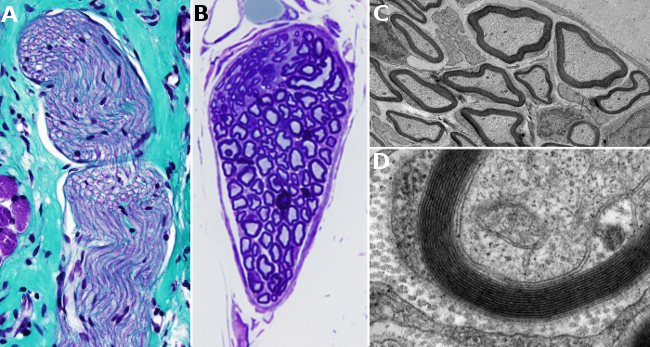
Species: rat (Rattus norvegicus. Mammal).
Technique: A) paraffin, Masson thrichrome; B) semithin, toluidin blue; C and D) transmission electron microscopy.
Nerves are bundles of axons located outside the central nervous system, which includes the encephalon and the spinal cord. Some nerves are quite long, like those extending from the spinal cord to the more distal parts of the limbs.
Nerves are made up of axons, Schwann cells (glia), and connective tissue. Axons, also known as nerve fibers, are enveloped by multiple folds of Schwann cell plasma membrane. When many folds are formed, they form layers that collectively constitute myelin, and so the axon is referred to as a myelinated axon. If only one fold covers the nerve fiber, whether completely or partially, it is referred to as an unmyelinated axon.
Nerve fibers, both myelinic and amyelinic, are covered by loose connective tissue known as endoneurium, which fills the space between the nerve fibers. Within the nerve, groups of axons join together to form fascicles, which are wrapped by connective tissue referred to as perineurium. In the same way, the nerve is covered by connective tissue known as epineurium (Figure 1). Large diameter nerves contain blood vessels running among the nerve fiber fascicles.

Nerves can be classified as afferent nerves, when they bring information to the central nervous system; efferent nerves, when information comes from the central nervous system; and mixed nerves, when they carry both afferent and efferent information. They also are classified as cranial nerves when they enter or leave the encephalon and spinal nerves when they enter or leave the spinal cord.