

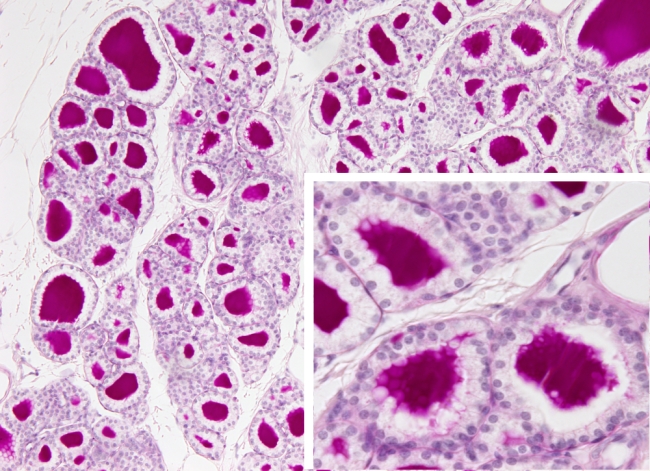
species: mouse (Mus musculus; mammal).
Technique: 8 µm paraffin thick section stained with PAS-hematoxylin.
The thyroid gland is one of the largest endocrine glands in the body and is located in the neck, before the trachea. It is composed of lobes separated by connective tissue through which blood vessels run; the processed hormones are released into these vessels. The lobes contain follicles, which are composed of follicular cells—forming a simple cubic epithelium—and colloid. Among the follicles are other cells called parafollicular cells. The endocrine glandular nature of the follicular and parafollicular cells stems from their ability to produce and release hormones that are then taken up and transported by the blood capillaries that traverse the thyroid. The follicular cells produce the thyroid hormones T3 (triiodothyronine) and T4 (thyroxine), while the parafollicular cells release calcitonin. The colloid fills the interior of the follicle and consists mainly of thyroglobulin, a protein produced by the follicular cells themselves that serves as a precursor for the synthesis of the thyroid hormones T3 and T4.
