


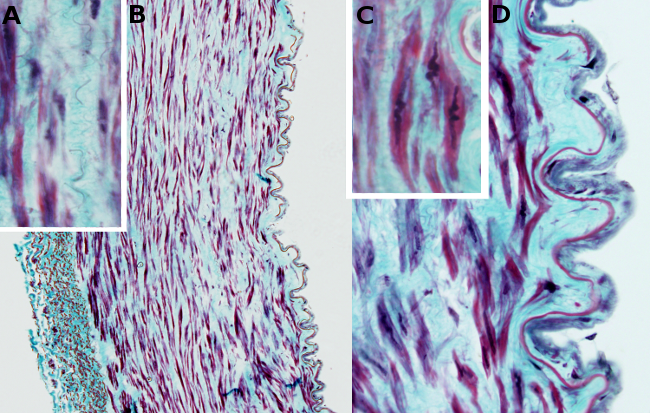
Species: rat (Rattus norvegicus. Mammal).
Technique: paraffin embedding, stained with Masson trichrome.
Elastic arteries are the largest type of arteries located close to the heart. Examples of elastic arteries include the aorta and pulmonary arteries. These arteries are made up of three layers: tunica intima, tunica media, and tunica adventitia. The tunica media and tunica adventitia contain a large amount of elastic fibers for resisting the blood pressure caused by heart beating and also for maintaining the blood pressure within the blood vessels during diastole, the phase when the ventricle relaxes.
The tunica intima is composed of endothelium, underlying connective tissue, and the elastic lamina. Besides forming a barrier between the bloodstream and the inner tissues, endothelial cells have additional roles like releasing substances into the blood, including chemokines, growth factors, and molecules for vasoconstriction and vasodilation.
The tunica media is very thick and is formed of smooth muscle cells arranged parallel to the internal surface (endothelium) of the artery. The diameter of the artery changes through the relaxation and contraction of these cells. During cell contraction, the shape of the nucleus twists, resembling a corkscrew. In this tunica there are no fibroblasts, meaning that the extracellular matrix, which is enriched in elastic fibers, is synthesized by the smooth muscle cells. Unlike the cardiac muscle cells, the smooth muscle cells of arteries can proliferate and repair damage to the artery wall.
The tunica adventitia is mainly consists of an extracellular matrix containing a high proportion of collagen and elastic fibers. Fibroblasts, together with macrophages, are the most frequent cells. Furthermore, a network of blood vessels, refereed to as "vasa vasorum" (vessels of the vessels), is observed. Some of these blood vessels, mostly capillaries, may give rise to branches that extend short distances in the tunica media. Nerve endings can also be found in the tunica adventitia, forming a net called "nervi vascularis" (nerves of the vessels).