


1. Sight
2. Hear
3. Taste
4. Smell
5. Skin senses
6. Blood pressure
On this page, we are going to deal with structures and systems responsible for gathering information coming from both outside and inside the animal body. These systems are commonly known as the senses. Although we will also deal with them on other pages related to other animal organs, a more detailed description is given here. The senses that get information from the environment are sight, hearing, smell, taste, and touch. Other tissular structures process the inner physiological state of the body, such as pain, temperature, body balance, and blood pressure.
1. Sight
In vertebrates, the eye is the sensory organ for detecting visible light. It is an ovoid structure made up of several tissue layers that are able to focus and project the light onto a layer of neurons, the retina. The retina transforms the light into nerve impulses that travel through the optic nerve (cranial nerve II) to the thalamic geniculate nucleus and other encephalic structures. In the occipital lobe of the encephalon, the visual information reaches the visual cortex through axonal projections originating from the geniculate nucleus (Figure 1).
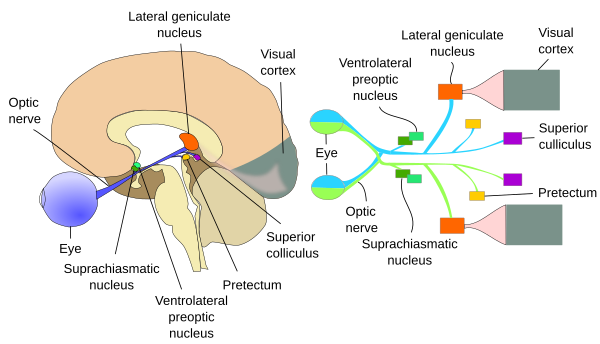
Eye
The eye is the structure that detects the light reflected by objects and transduces it into electrical information, which, after local processing, is sent to other parts of the encephalon for interpretation. Eyes are rounded and polarized structures. From the anterior to the posterior part, they are made up of the cornea, anterior chamber, iris, ciliary muscles, crystalline lens, vitreous body, retina, choroid, sclerotic, or sclera, and optic nerve. These components are distributed in three concentric layers, or tunics (excluding the crystalline): fibrous tunic, vascular tunic, and inner nervous tunic (Figure 2).
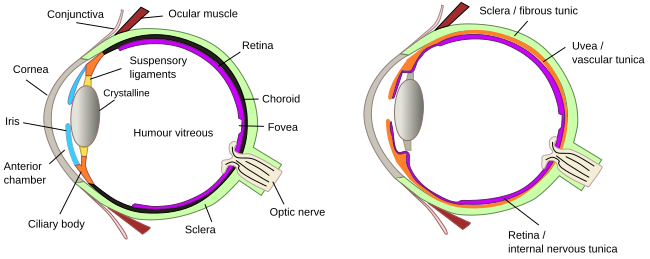
The cornea is the outermost part of the eye, so it is in contact with the air (Figure 3). It is a transparent structure that focuses the light and protects the eye surface. The optic properties of the cornea are a consequence of the arrangement and type of collagen fibers it contains. There are no blood vessels in the cornea, and that is why it is relatively easy to transplant this part of the eye during surgery.

The cornea is a sheet of tissue made up of five layers: corneal epithelium, Bowman's layer, stroma, Descemet's membrane, and endothelium (Figure 2). The corneal epithelium is the outermost layer. It is a stratified squamous epithelium containing many nervous fibers, and it can be easily self-repaired. The corneal epithelium is laterally continuous with the epithelium of the conjunctiva. The Bowman's layer lies immediately beneath the corneal epithelium. Bowman's layer contains collagen fibers but not elastic fibers. The stroma, found under the Bowman's layer, is the thicker layer, accounting for about 90% of the thickness of the cornea. The stroma consists of connective tissue conatining collagen fibers, mainly types I and IV, arranged in layers with different spatial orientations of the fibers between adjoining layers. There are also proteoglycans like chondroitin sulfate and keratan sulfate. Some cells are also present, such as fibroblasts and errant lymphocytes. Descemet's membrane lines the inner part of the stroma, and, actually, it is the basal lamina of the endothelium that follows. The endothelium is the innermost layer of the cornea and forms the anterior wall of the anterior chamber of the eye. The cornea is laterally connected to the sclera through a region known as the corneal limbus.
The ciliary body is found behind the iris and performs two main functions: release vitreous humor and change the shape of the crystalline to focus the light on the retina. It links the ora serrata of the choroid to the root of the iris, and it is connected to the crystalline by a ligament. The ciliary body shows a ring shape and appears triangular in cross-section (Figure 4). It is divided into two components: pars plicata and pars plana. Pars plicata is found close to the crystalline lens and is organized in finger-like structures known as ciliary processes, whereas pars plana shows a flattened form. The smooth muscle of the ciliary body is known as the ciliary muscle, which controls accommodation by changing the shape of the crystalline lens to focus the light on the retina. The internal part of the ciliary body is dense connective tissue with abundant elastic fibers and blood vessels. The ciliary epithelium is made up of two layers. The most internal one is pigmented and releases aqueous humor. The ciliary body, together with the iris and choroid, constitutes the uvea, or vascular tunica.
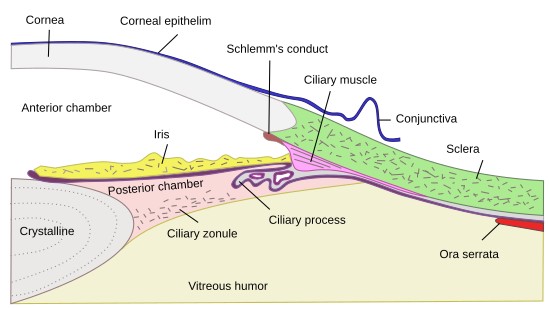
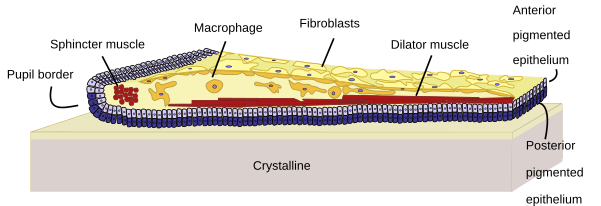
The iris is the structure of the eye that separates the anterior chamber from the posterior chamber, and it is attached to the ciliary body through its peripheral region. In the central area of the iris, there is an opening known as the pupil, through which light can reach the crystalline lens. The pupil area of the iris is the closest part to the pupil, and the peripheral part is known as the ciliary area. The iris consists of loosely arranged connective tissue with a rich blood supply. No matter the diameter, blood vessels show the same organization. They lack a layer of muscle. The posterior part, the deepest one, of the iris is a two-layered, highly pigmented epithelium, which gives color to the eyes depending on the amount and arrangement of the pigment. The iris works as an adjustable diaphragm thanks to the activity of two muscles. One of them is the sphincter of the pupil, which sets the diameter of the pupil. It is smooth muscle innervated by parasympathetic fibers from the ciliary ganglion and is arranged circularly. The other muscle is the dilator muscle, which increases the pupil's diameter (pupil dilation). It is composed of radially oriented myoepithelial muscle cells, which are innervated by sympathetic neurons of the superior cervical ganglion.
The crystalline lens (or eye lens) is located behind the pupil and shows a transparent biconvex body. Covering the crystalline, there is a transparent, thick outer layer known as the capsule, which contains similar molecular composition than the basal lamina of other tissues. Below the capsule, in the superficial part of the crystalline lens, there is a one-cell-thick layer of cuboidal cells that is not present in the peripheral parts. Besides these cuboidal cells, most of the crystalline lens is made up of cells known as crystallie fibers because they are very long, up to 10 mm, but very thin, measuring just a few µm. These cells contain a high concentration of the protein crystalline, which accounts for almost 90% of the total protein content of the crystalline lens and is responsible for the optical features. The cornea and crystalline lens work together to focus the light on the retina. The crystalline lens can be stretched by the muscles of the ciliary body, changing the curvature and thus the focusing properties. In addition, its position depends on ciliary fibers.
The vitreous humor fills the cavity between the crystalline lens and the retina. It is a gelatinous substance with similar transparency to crystal glass and composed of an aqueous solution with abundant type II and XI collagen and hyaluronan. It also contains some scattered cells known as hyalocytes.
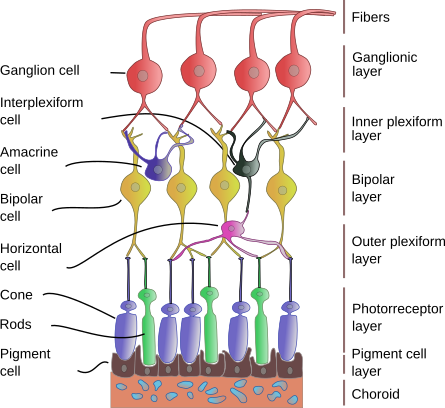
The retina is the light-sensing structure of the eye and the innermost tunica of the eye. It arises from an evagination of the central nervous system during embryonic development. This evagination folds to form a cup-shaped structure with two layers: a pigmented external one and a nervous internal one, which is the retina. The retina is composed of several types of neurons: those that convert light into electrochemical gradients (that is, photoreceptors), neurons that receive and process the information from photoreceptors, and neurons that send the processed information through the optic nerve to the encephalon. There are up to 10 layers of neurons in the retina (Figure 6). The outermost one is the photoreceptor layer, which has two types of photoreceptors: cones and rods. Cones are specialized in perceiving colors, whereas rods respond to light intensity. Cones are more abundant in the fovea, an area of the retina where the eye focuses the light. When we rotate the eyes to see an object, we are actually moving the fovea to receive the focused light coming from the object we are interested in. The axons of the optic nerve arise from neurons located in the innermost layer of the retina, referred to as the ganglion cell layer (or ganglionic layer). This is why these axons must cross the photoreceptor layer, leaving a spot without photoreceptors, which is then a blind spot. We are not aware of this blind spot because our encephalon "fills" for us. The pigment layer is the outermost layer that results from the initial evagination and does not contain neurons but pigment cells. The pigments prevent light dispersion, contributing to sharper vision. This layer is in close contact with the photoreceptor layer and is also involved in maintaining the homeostasis of photoreceptors.
2. Hearing
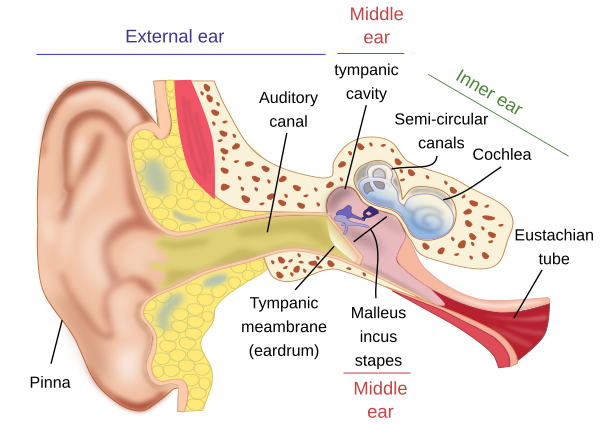
The so-called auditory system consists of two subsystems: auditory and vestibular. The auditory component perceives sounds and transduces them into electrical signals. The vestibular component maintains the balance of the body and spatial orientation. The auditory system is spatially divided into three components: the external ear, the middle ear, and the inner ear (Figure 7).
Outer ear
The outer ear is composed of the auricle (pinna) and the auditory canal, which communicates the outside environment to the tympanic membrane, or eardrum. The auricle is usually oval and mostly made up of elastic cartilage and integument (skin). It is delimited by a thin epidermis and many hair follicles, though it depends on the animal species. The auditory canal is a long, tube-like structure that starts in the auricle and ends in the tympanic membrane. The external part (which is continuous with the auricle) contains many glands, known as ceruminous glands, that release lipid components. These substances get mixed with the secretion of the sebaceous glands, forming the earwax, or cerumen. The internal part of the auditory canal is encased in the cranial bone, where both types of glands decrease in number.
Middle ear
The middle ear is found after the auditory canal. It is a cavity, known as the tympanic cavity, enclosed in the cranial temporal bone. The tympanic membrane separates the auditory canal from the tympanic cavity. Within the tympanic cavity, there are three tiny bones (or ossicles): the malleus, the incus, and the stapes, along with the muscles that move them (Figure 8). The Eustachian tube is also part of the middle ear and connects the tympanic cavity with the pharynx. This connection allows for a balance between the air pressure in the oral cavity (atmospheric pressure) and that in the tympanic cavity. The middle ear is separated from the inner ear by the bone of the inner ear.
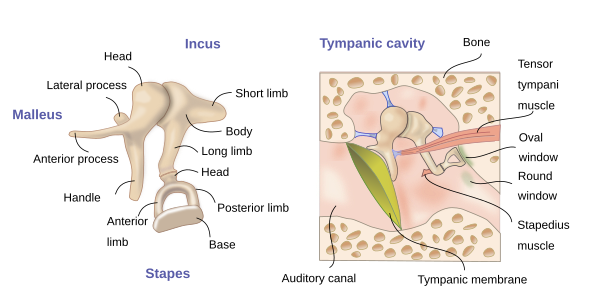
The function of the middle ear is to transform the air waves, which carry sound information, into the mechanical movements of the ossicles, which convey this information to the inner ear. The process begins with the pressure of the air waves coming through the auditory canal and impacting the tympanic membrane. Vibrations of the tympanic membrane move the ossicles of the middle ear: first the malleus ossicle, which is in contact with the tympanic membrane, second the incus, and third the stapes. The stapes convey the information to the labyrinth of the inner ear (see below), where it creates fluid currents. The communication between the stapes and the labyrinth occurs through the oval window (fenestra vestibuli) and tthe round window (fenestra cochleae) of the bone. There are two muscles in the tympanic cavity, one attached to the malleus and the other to the stapes. The malleus keeps the tension of the tympanic membrane, and the stapes compensates the movement of the incus. Both muscles are important for alleviating the higher vibrations and protecting against very loud sounds.
Inner ear
The inner ear is the labyrinth (Figure 9). There are two parts: the bony labyrinth and the membranous labyrinth. The bony labyrinth is found within the temporal cranial bone and comprises the semicircular canals, vestibule, and cochlea. The vestibule is at the center of the bony labyrinth, and the semicircular canals are connected with the vestibule at both of their ends. There are three semicircular canals inside the bone: superior, posterior, and lateral. The inner cavity of the canals is continuous with the space of the vestibule. On the other side, the vestibule is connected with the cochlea, which is a spiral-shaped passage.
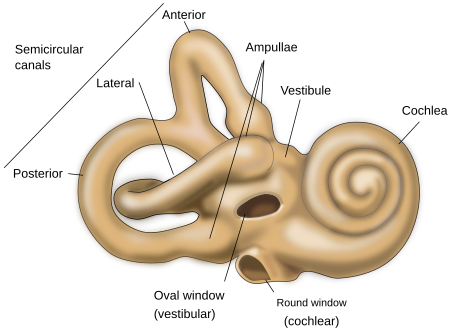
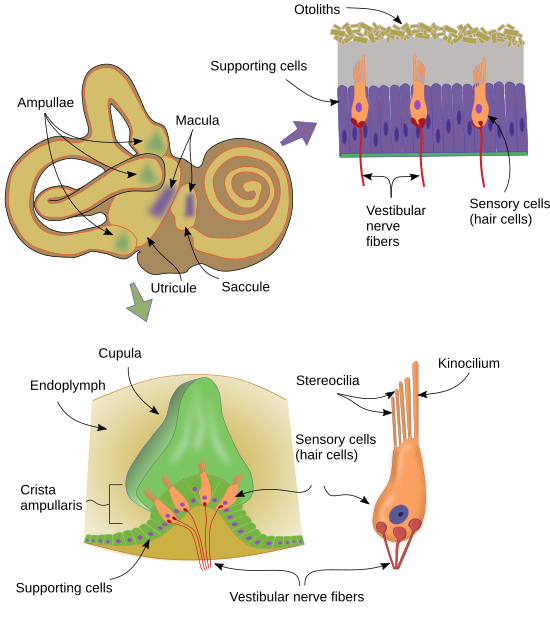
The membranous labyrinth is located within the cavity of the bony labyrinth. In the vestibule, there are two chambers: the utricle and the saccule. The utricle chamber is connected with the cavities of the membranous labyrinth, with its membrane lining the internal surface of the semicircular canals. The utricle and the membranous semicircular canals form the vestibular labyrinth. The saccule is connected with the cochlear canal, which extends through the interior of the cochlea. The saccule and cochlear canal form the cochlear labyrinth. All these cavities are filled with the liquid substance endolymph. On the other hand, the perilymph fills the vestibular and tympanic ducts of the cochlea.
Some regions of the labyrinth have receptor cells that can sense the change in body speed and position. The sound is detected by the organ of Corti by means of the ossicles of the middle ear (Figure 10). These cells transform the changes in the movement of the surrounding liquid (endolymph) into electrical signals. Transduction is done by cellular apical structures known as stereocilia, which are actually modified microvilli, and by a real cilium known as the kinocilium. Within the ampullary crests, located between the semicircular canals and the utricle, the receptor cells (or hair cells) sense angular movements of the head thanks to the bending of the stereocilia and kinocilia by the flow of the endolymph and convert the mechanical inputs into electrical information. In the saccule and utricle, there are also receptors that can sense gravity (the vertical or horizontal position of the body) as well as lineal speed changes.
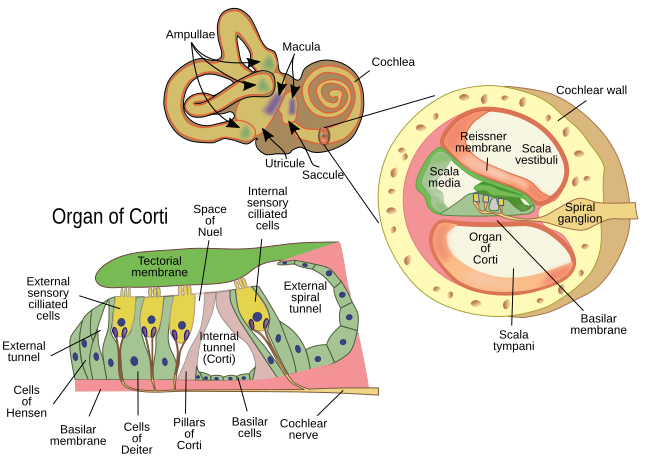
The organ of Corti is found inside the cochlear canal, more precisely in the scala media (Figure 11). It is composed of an epithelial layer containing ciliated cells. The movements of the inner ear ossicles are converted into endolymph flow, which bend the cilia and kinocilia and generate the electrochemical gradients that carry the sound information.
The inner ear is innervated by the vestibular nerve (VIII). This nerve is divided into two branches: vestibular and cochlear. The vestibular branch innervates the cell receptors of the labyrinth and vestibule, whereas the cochlear branch innervates the auditory receptors. Vestibular nerves have their neuronal soma in the vestibular ganglia (of which there are two), located outside the labyrinth. The ganglion of Corti, or spiral ganglion, forms the cochlear branch and is located in the cochlea.
3. Taste
The taste sense recognizes dissolved molecules that enter the mouth, normally food. However, the flavor of food primarily relies on smell, or the olfactory sense. The structures responsible for perceiving taste information are the taste buds, which mostly localize in the tongue papillae, although they can also be found in other locations of the oral cavity. Papillae are protrusions of the tongue surface and are named according to their morphology: filiform, fungiform, foliate, and calyciform. Taste buttons are found on the tips of the fungiform papillae and on the sides and inner walls of the calyciform papillae.
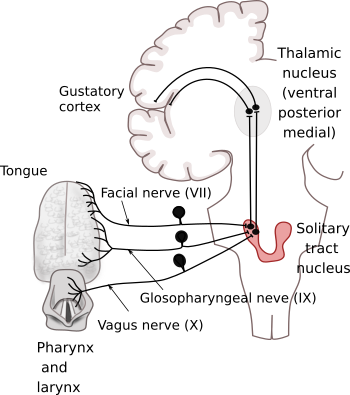
The taste receptor cells are found in the taste buds. These receptors make synaptic contacts with primary sensory axons that enter the encephalon through the IX and VII cranial nerves. They innervate the nucleus of the solitary tract, which in turn sends axons to several thalamic nuclei. From the thalamus, gustatory information is sent to the gustatory cortex.
Tongue
The tongue is the organ where papillae with most of the taste buds are located. Briefly, the tongue is a striated skeletal muscle inside the oral cavity that moves food and assists in modulating sounds emitted by some animals.
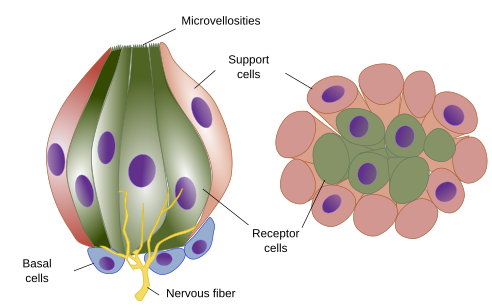
Taste buds are structures that recognize molecules responsible for taste. They are found in the tongue papillae and in other locations of the oral cavity, such as the palate and epiglottis. The cells of taste buds are organized like an onion (without the green leaves), with the apical part in contact with the outer surface (Figure 12). They are formed of three cellular types: support, neuroepithelial, and basal cells. Supporting cells are located at the periphery of the taste bud. Neuroepithelial cells are found more internally. There are about 10 to 14 neuroepithelial cells per taste bud. These cells are the chemoreceptors that recognize taste molecules and transduce this information into signals that are transmitted to nerve terminals. These nerve terminals are in close apposition to the membrane of the neuroepithelial cells. The basal cells, the third type, are located basally and at the periphery of the taste bud, in contact with the basal lamina. Basal cells have been proposed to be stem cells capable of dividing, differentiating, and replacing the cells that die during normal renewal of the taste bud cell population.
The information produced by taste bud receptor cells, after they recognize taste molecules, is gathered by different nerves depending on the zone of the tongue where the taste buds are located (Figure 13). Those found at the anterior (near the tip) and medial regions are innervated by the facial nerve (VII), those at the posterior part of the tongue and in the pharyngeal epithelium are innervated by the glossopharyngeal nerve (IX), and those located in the larynx and epiglottis are innervated by the vagus nerve (X). Although these nerves enter the rhombencephalon at different levels, the information converges at the rhombencephalic nucleus of the solitary tract, and it is subsequently sent to thalamic centers, which send axons to the gustatory cortex. There are other lateral pathways and outputs from the gustatory cortex that associate the gustatory information with the rest of the relevant information for the organism. For instance, flavor is a mix of taste information and smell information, i.e., two different types of information coming from different receptors and different nervous pathways and processed separately should be combined.
4. Olfaction
Olfaction, the sense of smell, is probably the most ancient of all the senses. It is involved in feeding, social communication, predation behavior, spatial orientation, offspring care, parental imprinting, and so on. The high relevance of this sense is clearly shown when the olfaction system is damaged. In rats, it causes alterations to sleeping patterns and sexual behavior, increases aggressiveness, and leads to poor care for progeny and anxiety. The basic components of the olfactory system have been conserved during evolution for millions of years. It is of interest that insects show a similar basic molecular mechanism for olfaction to that of vertebrates, and the first cellular components of the olfactory system are similar.
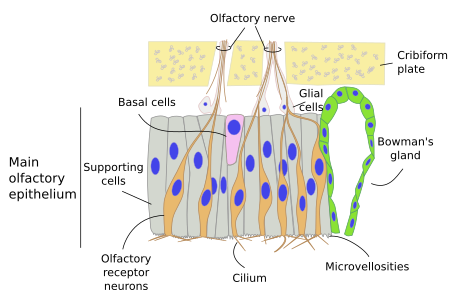
The process of smell begins in the olfactory epithelium, located in the deeper part of the nasal cavity, close to the cranial bone (Figure 14). The olfactory epithelium contains neurons (olfactory receptor neurons) with transmembrane receptors that recognize olfactory molecules. These neurons have axons that form the olfactory nerve (nerve I), which crosses the cranial bone through the cribriform plate and reaches the olfactory bulb, the most rostral part of the encephalon. The axons of the olfactory nerve split into bundles, and their terminals form round networks known as olfactory glomeruli. In each glomerulus, the primary olfactory information is transmitted to other neurons, mainly mitral cells. From the olfactory bulb, the olfactory information is sent to other deep encephalic areas, where it is processed and confronted with other types of information. For instance, the smell of food has not the same impact on the behavior of the animal when it is hungry as when it is satiated.
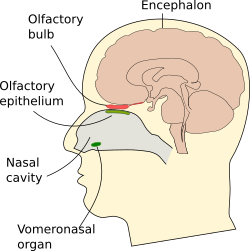
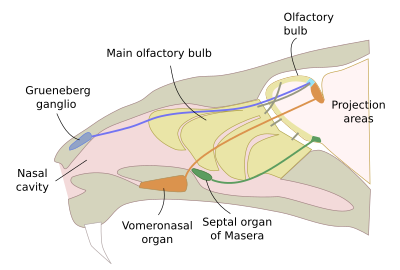
Olfactory receptor neurons in the nasal cavity are organized in different groups. Most of them are found in the main olfactory epithelium, near the cribriform plate. Other olfactory receptor neurons are found in the vomeronasal organ, which for humans is located in a bony cavity of the septum at the base of the nasal cavity. However, fish lack the vomeronasal organ. In non-human vertebrates, there are other olfactory structures, like the septal organ of Masera and the organ of Grueneberg (Figure 15). It is thought that each of these structures senses different olfactory information.
Main olfactory epithelium
The main olfactory epithelium is pseudostratified and consists of several types of cells. In humans, it is about 1 cm2. The main cell type is the olfactory receptor neuron, which recognizes the olfactory molecules and subsequently produces an electric response by depolarization. These neurons are bipolar cells with an apical (free) membrane with cilia or microvilli, where the transmembrane olfactory receptors are located. Each receptor neuron expresses exclusively one type of transmembrane olfactory receptor, and there are thousands of different transmembrane olfactory receptors. Thus, in the main olfactory epithelium, there are thousands of olfactory receptor neuron populations that are able to sense a specific olfactory signal. At their basal domain, the olfactory receptor neurons have an axon that leaves the main olfactory epithelium that joins other olfactory axons, and together cross the cribiform plate on their way to the olfactory bulb. Interspersed with olfactory receptor neurons, there are the supporting cells, which are involved in supporting and, likely, in the electrical insulation of the olfactory receptor neurons. Another cell type forms the Bowman's glands, which synthesize and release mucous substances that cover the outer surface of the epithelium. Finally, at the basal part of the main olfactory epithelium, there are the basal cells. The function of the basal cells is to proliferate and replace the other cell types of the epithelium. This is one salient feature of the olfactory epithelium: a permanent turnover, where the cells die and are replaced by new ones.
5. Skin senses
The skin, the largest sensory organ of the body, has several types of receptors that collect information from the outside environment: mechanical (touch, pressure, and vibration), temperature, and pain receptors (mechanical and chemical harm). Unlike other senses that goup the receptors in an organ, cutaneous receptors are scattered throughout the skin of the body as either free or encapsulated nerve endings. Different parts of the body show different receptor densities. These receptors show a similar molecular mechanism: a sensory input changes the shape or affects the nerve membrane so that the electrochemical membrane potential is modified, which is transformed into an action potential that travels via nerve fibers to neuronal bodies. From the neuronal body, the information is sent to the central nervous system.
Cutaneous receptors can be classified regarding their location, the type of stimulus they are responding to, or how their nerve endings are organized.
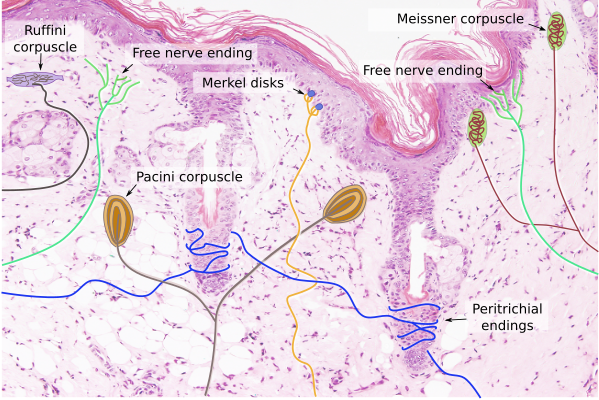
Free nerve endings. They are the naked final ends of the nerves, not wrapped with myelin (myelinization stops before these final segments), nor with any other structure. They can be mechanoreceptors (touch), nociceptors (pain), or thermoreceptors (temperature). They are distributed in both the epidermis and dermis.
Free nerve endings may be associated to particular types of cells (Figure 17). For instance, Merkel disks are cup-shaped free endings that partially coat the Merkel cells in the epidermis. Merkel disks are mechanoreceptors with high sensitivity and a slow adaptation to stimuli, so they can inform about long-lasting stimuli. They are abundant in the fingertips and lips, although they are also found scattered in the skin of other areas of the body. Other free nerve endings, referred to as peritrichial endings, are located around the hair follicles. Peritrichial endings are mechanoreceptors usually showing a fast adaptation to the stimulus, i.e., they respond to changes in the stimulus, even slight ones, but not to a sustained stimulus.
Receptors involved in pain transmission are very small and stimulated by molecules released by damaged cells. Analgesics work to prevent this activation at different levels, depending on the drug.
Encapsulated receptors. The nerve endings are wrapped by other cells in the encapsulated receptors, commonly connective tissue cells, which are arranged as onion leaves. Most of these receptors are mechanoreceptors, although some of them are thermoreceptors, and they are more often found in the dermis.
Meissner's corpuscles. They are encapsulated receptors found in the dermis, usually in the dermal papillae of the skin lacking hair follicles. The capsule is made up of several layers of connective tissue, and the nerve endings are intertwined within these layers. A mechanical input causes the layers to be separated from each other, triggering a change in the membrane of the nerve. These receptors show slow adaptation so that even if the stimulus persists, the transmission of the information stops. This ability is very useful for discerning the movement of objects over the skin, but forget about them if they stay quiet. Meissner's receptors are so sensitive that the brain can discern the spatial direction of the movement or the texture of the object. They are abundant at the fingertips and lips. Those located in the skin of the genitals and nipples are known as the genital corpuscles.
Pacinian corpuscles. They are encapsulated receptors found in the deep dermis, pleura, nipples, pancreas, tendons, penis, and clitoris, as well as in more internal locations like the urinary bladder and joints. They are stimulated by fast movements like vibrations and by strong pressure forces. The size and morphology of Pacinian corpuscles are variable, and it looks like the deeper the location, the larger they are. Golgi-Mazzoni corpuscles show similar organization to the Pacinian corpuscles, yet they are simpler and mainly located at the fingertips.
Ruffini corpuscles. They are encapsulated receptors found deep in the skin. They show slow adaptation, so they respond to long-lasting stimuli. These receptors are also found in the joint capsules, where they process information about the rotation of the bones. Besides mechanical stimuli, they can also sense temperature and pain.
Krause corpuscles. These are encapsulated receptors found in the dermis and oral cavity, where they detect pressure and temperature. They show fast adaptation.
6. Blood pressure
Blood pressure is controlled by the so-called baroreceptor reflex. It is very effective and keeps the blood pressure within a narrow range of values. The baroreceptor reflex consists of an afferent component that brings information about the state of the blood pressure to the central nervous system and an efferent component that influences the mechanisms that change the blood pressure.
The afferent component consists of nerve terminals known as baroreceptors. These are mechanoreceptors found in the walls of the blood vessels and heart and are stimulated when the walls are stretched. There are high-pressure baroreceptors and low-pressure baroreceptors. High-pressure baroreceptors are located in the carotid sinus and in the aortic arcs, while low-pressure baroreceptors are found in the atrium and heart ventricles, as well as in the lung veins.
The nerves that carry the blood pressure information of the aortic arches and carotid sinus enter the encephalon through the vagus (X) and glossopharyngeal (IX) nerves, respectively. This information reaches the nucleus of the solitary tract of the rhombencephalon. Then, the processed information is sent through the efferent component (autonomic nervous system) and modifies the muscle contractions of the blood vessels and heartbeat rhythm.
The activation of baroreceptors also induces the release of vasopressin (an antidiuretic hormone) by the hypothalamus, leading to a feeling of thirst, and the release of renin by the kidney, modifying vasoconstriction (mediated by angiotensin II), sodium reabsorption, and so on.
-
Bibliography ↷
-
Salazar I, Sánchez-Quinteiro P. (2019). The risk of extrapolation in neuroanatomy: the case of the mammalian vomeronasal system. Frontiers in neuroanatomy. 3: 22.

-
 Peripheral nervous system