

The encephalon is the rostral part of the central nervous system. From caudal to rostral, it consists of three major compartments: rhombencephalon (hindbrain), mesencephalon (midbrain), and prosencephalon (forebrain). Rhombencephalon and mesencephalon are together known as the brainstem.
The rhombencephalon is found between the spinal cord and the mesencephalon (Figures 1 and 2). Anatomically, it is divided into transversal segments known as rhombomeres (rh; Figure 2). The cells within each rhombomere are confined and cannot cross the boundaries between adjoining rhombomeres because of attraction and repulsion adhesion mechanisms. Thus, clusters of neurons can get specialized in processing particular information in each segment. This anatomical and functional organization of segments is called metameric. During development, the expression pattern of the Hox genes family establishes the identity and borders of the different rhombomeres.
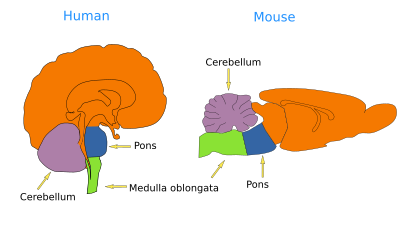
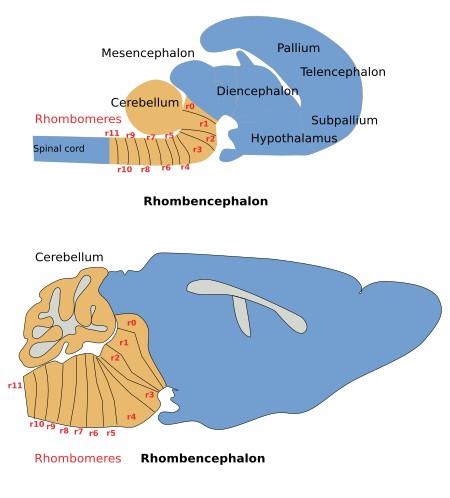
Currently, eleven rhombomeres (rh; Figure 2) have been identified, with rh11 being the most caudally and rh1 the most rostrally. The isthmic region, also referred to as rh0, is located rostral to rh1. The part of the rhombencephalon that spans from rh11 to rh4 is usually known as the medulla oblongata (or myelencephalon; Figures 1, 2, and 3). The ventral part of rh3 to rh1, known as the pons or pontine region, is larger than other ventral parts of the rhombencephalon. The cerebellum is an expansion of the dorsal part of rh1. From rh3 to rh1, and the structures they contain, form the so-called metencephalon. The isthmic region (rh0), or rhombencephalic isthmus, forms the boundary with the caudal mesencephalon, or midbrain.
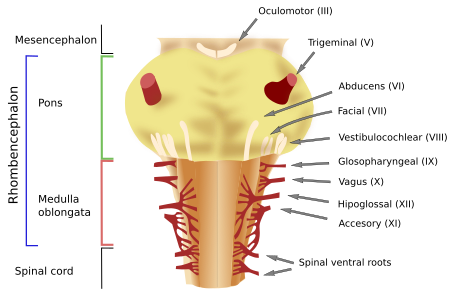
There are 12 pairs of cranial nerves in vertebrates (12 individual nerves on each side) numbered using Roman numerals (Figure 3) and ordered from rostral to caudal. The cranial nerves IV to XII are found in the rhombencephalon. Each of them innervates specific body structures.
IV, trochlear, or pathetic nerve (motor): it is found in the isthmic region and innervates the extraocular superior oblique muscle.
V, trigeminal nerve (mixed): it is found in the pontine region, brings sensory information from the head and face, and drives the muscles involved in chewing.
VI, abducens, or external oculomotor nerve (motor): it is found between the pons and medulla oblongata and innervates the extraocular lateral rectus muscle of the eye.
VII, facial nerve (mixed): it is found in the rostral medulla oblongata. It carries information from the gustatory receptors of the two-thirds of the rostral tongue, sensory somatic information from the posterior area of the internal auditory canal, and information from the outer ear. It innervates muscles involved in facial expressions and also those that control several glands, like the nasal, palatine, pharyngeal, salivary (sublingual and submaxillary), and lacrimal glands.
VIII, vestibulocochlear nerve (sensory): it is found between the pons and medulla oblongata. It brings auditory information (sense of hearing) from the cochlea as well as information coming from the sensory structures of the membranous labyrinth in the inner ear (semicircular canals, saccule, and utricle) to maintain the body's balance.
IX, glossopharyngeal nerve (mixed): it is found in the middle part of the medulla oblongata. It carries sensory information from the taste buds of the posterior one-third of the tongue and visceral information from several regions, including the pharynx. This nerve innervates glands, like the parathyroid gland, and one muscle of the pharynx.
X, vagus nerve (mixed): it is found in the caudal part of the medulla oblongata. It brings gustatory sensory information from the epiglottis and visceral sensory information from the thoracic and abdominal viscera. It innervates most of the laryngeal muscles and all the pharynx muscles, controls the vocal cords, and is also in charge of the smooth muscles of the thoracic and abdominal viscera.
XI, accessory nerve (motor): it is located at the caudal part of the medulla oblongata. Actually, it is composed of several roots that join at the caudal part of the rhombencephalon. As part of the nerve, there are also some ventral roots coming from the rostral level of the spinal cord. The rhombencephalic component of the nerve innervates larynx muscles, whereas the spinal cord component innervates muscles of the neck (sternocleidomastoid and trapezius).
XII, hypoglossal nerve (motor): it localizes at the caudal part of the medulla oblongata, and it is actually made up of several roots. It innervates the intrinsic muscles of the tongue, which are involved in eating and speaking.
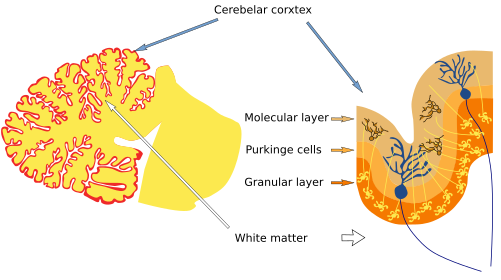
The cerebellum is a dorsal outgrowth of the first rhombomere (rh1). It has more or less parallel transversal grooves, more or less parallel to each other. There are two cerebellar hemispheres divided into lobules that, from rostral to caudal, are named as anterior, posterior, and flocculonodular. In transversal sections, the inner region, known as white matter, contains more abundant neuronal processes (neuropile) than neuronal bodies. The cerebellar cortex lies on top of white matter, with neurons arranged in a folded layer (Figure 4). Granular and Purkinje cells are found in the cerebellar cortex. In the deepest region of the cerebellum, neurons are distributed into the deep cerebellar nuclei, which give rise to the main output of cerebellar information. The vestibular lateral nuclei are another way out for cerebellar information. The cerebellum is involved in fine coordination of movements and in awareness, and, in humans, it also participates in language processing.
The rhombencephalon is regarded as a primitive part of the encephalon due to its structural similarities observed among phylogenetically distant species, like fish, amphibians, and mammals. It could be said that the organization of the rhombencephalon was invented by the vertebrate ancestor a long time ago, that it did work out, and that there have been no major modifications throughout the evolution of vertebrates ever since.
This conserved organization may result from the crucial roles that the rhombencephalon performs in vital functions for animal survival, such as breathing, blood pressure regulation, and heartbeat rhythm. It is also a relay station for sensory information such as touch, taste, hearing, and body balance. The animal cannot survive without properly performing all these functions. Different rhombencephalic compartments are involved in different functions:
Medulla oblongata: breathing, food and water swallowing, muscle tone, digestion, and heartbeat rhythm.
Pons: awareness level, motor control, ocular movement, sleep, and awareness.
Cerebellum: fine-tuned movements, body posture, body equilibrium, and modulation of body movements.
The rhombencephalon is also an important information relay or intermediary station between the more rostral encephalon and the spinal cord or some muscles. In the ventromedial region, there is an extended population of neurons known as the reticular formation. It contains many motor nuclei (groups of neurons that innervate muscles) that get inputs from the cortex and send axons that bundle as cranial nerves (mentioned above), which leave the rhombencephalon to innervate different muscles and produce movement.
-
Bibliography ↷
-
Bibliography
Cordes SP. 2001. Molecular genetics of cranial nerve development in mouse. Nature Reviews in Neuroscience 2, 611-623.
Puelles L, Martínez S, Martínez de la Torre M. 2008. Neuroanatomía. Editorial Médica Panamericana S.A. ISBN: 978-84-7903-453-5.
-
 Spinal cord