


The nervous system allows animals to communicate with their outer environment as well as with their own bodies. From outside, animals gather information through the sense organs (such as eyes, taste buds, olfactory epithelium, and sensory nerve terminals of the integument sensitive to touch and temperature). It is remarkable that the main type of response of the nervous system to stimuli is through muscle contraction, i.e., movements. Although other responses are possible, such as the release of hormones. The ability to awareness, think, feelings, emotions, and all those traits regarded as superior human features are caused by the activity of the nervous system. These human features, likely found to some extent in certain animals, do not solely arise from interactions with the outer world or the state of the body. In addition, the nervous system allows us to reproduce, which is perhaps its main function from an evolutionary point of view. The encephalon, part of the central nervous system, is regarded as the most complex organ of the animal kingdom, and some authors suggest that understanding the detailed mechanisms of the encephalon at work is one of the main challenges, not just for biology but for science as a whole.
The nervous system has been traditionally divided into the central nervous system and the peripheral nervous system (Figures 1 and 2). The central nervous system consists of the encephalon (brain) and the spinal cord. The peripheral nervous system is made up of many neurons, generally grouped into ganglia, plexuses, and nerves distributed throughout the body.
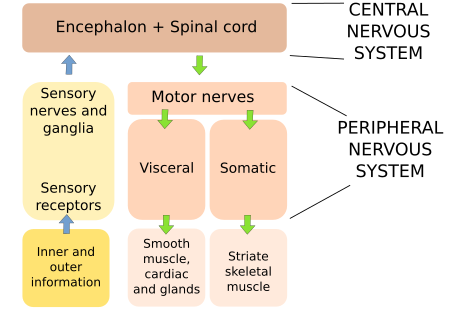

The nervous system is made up of neurons and glial cells. Although neurons get more attention, glial cells are indispensable. There are around 86000 million neurons in the human encephalon and a similar number of glia depending on the species. Neurons communicate with each other mainly through synapses. A neuron may send information to thousands of neurons via synapses, and a neuron may receive information from thousands of other distinct neurons. Furthermore, the type of information exchanged between neurons is diverse, and the impact of an identical signal on a target neuron may elicit different responses depending on the type of receptors, the particular physiological state of the target neuron at that moment, and the information concurrently received from other neurons. With these numbers in mind and the complex communication process between neurons, it is easy to picture the challenge for neurobiologists.
It is worth noting that neurons in invertebrates are the same neuronal type as the neurons in a vertebrate, sharing the same features. What distinguishes the vertebrate brain and the invertebrate ganglia lies in the number of neurons and the functional circuits they make.
-
Bibliography ↷
-
Bibliography
Purves D. 2007. Neuroscience. 4ª edición. Sinauer Associates, Inc.
-
 Introduction