


The mesencephalon is found between the rhombencephalon and the diencephalon (Figure 1). It is also known as the midbrain. In humans, it is 2.5 cm in length. Despite its small size, many essential functions are performed by the mesencephalon, such as vigilance, response to pain, motor coordination, control of eye movement, and vision and sound processing. In addition, many axonal tracts travel through the mesencephalon, both sensory bundles toward the thalamus and descending pathways from the cerebral cortex.
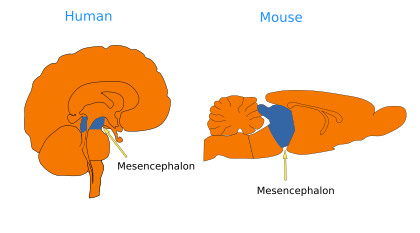
Along the dorsoventral axis, the mesencephalon is anatomically divided into the alar plate (dorsal) and basal plate (ventral). The four colliculi (corpora quadrigemina) are found in the most dorsal part of the alar plate and the tegmentum in the basal plate. In humans, there are prominent columnar structures in the ventral mesencephalon, known as cerebral peduncles, which contain the descending cortical projections (pyramidal pathway).
At the mesencephalon roof (most dorsal alar plate), the corpora quadrigemina consists of four small protrusions known as colliculi, with two superior (rostral; Figure 2) and two inferior (caudal). The superior colliculi are involved with vision and eye reflexes. In those animals lacking a visual cortex, the superior colliculi are the major responsible for visual information processing. They receive information from the retina and cerebral cortex, as well as from the rhombencephalon and spinal cord. Damage in the superior colliculi leads to the inability to track the movement of an object with the eyes. The inferior colliculi, or torus semicircularis, are involved in processing the auditory information. The neurons of the inferior colliculi are arranged in layers. Lesions in both inferior colliculi leads to deafness and damage in one colliculus does not allow to localize the source of the sounds in the 3D space.
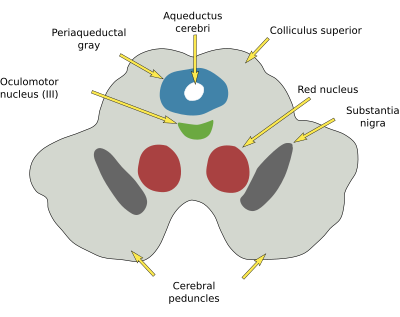
The tegmentum is found in the basal plate. It contains the periaqueductal gray, which is a cluster of nuclei around the mesencephalic aqueduct that extends rostrally toward the diencephalon and caudally toward the rhombencephalon. These nuclei are organized into four longitudinal columns and perform several functions, but generally, this region is related to pain processing.
The reticular formation is also found within the tegmentum. It is an elongated structure in the ventral midline, composed of several neuronal clusters. There are rostral and caudal regions of the reticular formation that are specialized for different functions.
The red nucleus is a group of neurons found in the rostral and central tegmentum. The red color is because of dense blood vessel vascularization (more iron). It is involved in motor control. It receives inputs from the motor cortex and cerebellum and sends processed information to motoneurons of the spinal cord.
The substantia nigra is found in the ventral tegmentum, just above the peduncles. The dark color results from the elevated level of melanin. In adult mammals, about 75% of the dopaminergic neurons localize in the mesencephalon, more abundantly in the pars compacta of the substantia nigra (SNc), which projects to the dorsal striatum (subpallium; nigro-striatal pathway) and is involved in voluntary movements. These dopaminergic neurons are lost during Parkinson's disease. The other two large dopaminergic regions are the ventral tegmental area (VTA) and the retrorubral field (RRF), which send information to the ventral striatum and the entorhinal cortex (mesocorticolimbic pathway). These connections are related to emotional and reward-related behavior. Conditions such as schizophrenia, addiction, and depression are influenced by these circuits.
The trochlear nucleus is found ventral to the periaqueductal gray and innervates the ocular muscles. The trochlear nerve (IV) crosses the mesencephalic midline and exits the encephalon through the dorsal region. These two features are unique when compared with the other cranial nerves.
The oculomotor nucleus is located in the mesencephalic tegmentum, under the rostral colliculi, and ventral to the periaqueductal gray. Its axons form the oculomotor nerve (III). In most vertebrates, the oculomotor nerve innervates four extraocular muscles (three rectus and one oblique), the elevator of the superior eyelid, and the intrinsic eye muscles (ciliary muscles and pupil).
-
Bibliography ↷
-
Bibliography
Puelles L, Martínez S, Martínez de la Torre M. 2008. Neuroanatomía. Editorial Mé;dica Panamericana S.A. ISBN: 978-84-7903-453-5.
-
 Rhombencephalon