

Plant tissues. Support
SCLERENCHYMA FIBERS
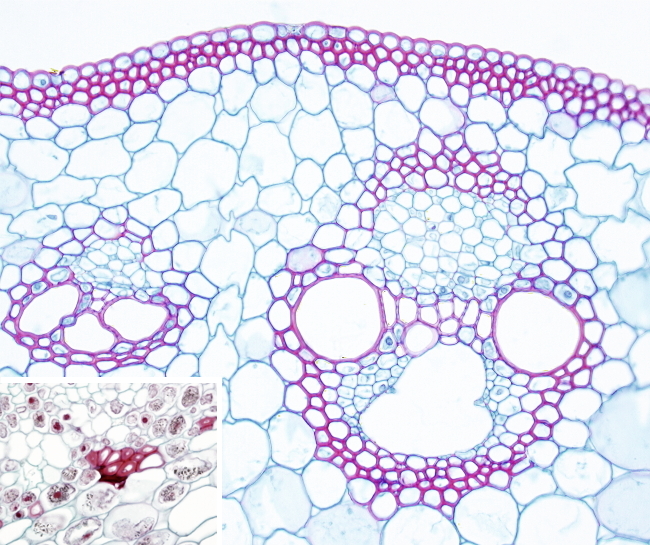
Species: corn (Zea mays).
Technique: paraffine embedding, section stained with Alcian blue / safranin.
The classification of sclerenchyma fibers is based on their location, because it is difficult to make subtypes based on cell features, i.e., they show similar morphology. In the image above, a monocot stem, sclerenchyma fibers can be found beneath the epidermis, organized in two or three layers of cells. They are known as cortical fibers. Perivascular fibers are found protecting vascular bundles. Xylary fibers are components of the primary xylem.
The sclerenchyma tissue is complex. The two types of cells that make up this tissue, fibers and sclereids, are identified by their origin, position, and morphology. Fibers are elongated and fusiform cells, while sclereids show a diverse morphology, typically more isodiametric than fibers. The origin of the two cell types is not enetirely known, but it is thought that fibers arise after differentiation of meristematic cells, while sclereids originate from collenchyma or parenchyma cells that have lignified their cell walls.
The sclerenchyma fibers are elongated cells with tapered ends, possesing a secondary cellf variable thickness and different levels of lignification. Auxin and gibberellins influence lignification and differentiation of sclerenchyma fibers in vascular tissues. The secondary cell wall of some fibers may be so thick that it fills the entire cell. Most fibers are dead at maturity, though some fibers reamin alive in the xylem of some dicot species. Because of their strength and resistance to mechanical forces, fibers have been used to make commercial strands, therefore having an economical interest. The fibers obtained from the leaves of some monocotyledons have commercial value in producing clothing and other fabrics.