
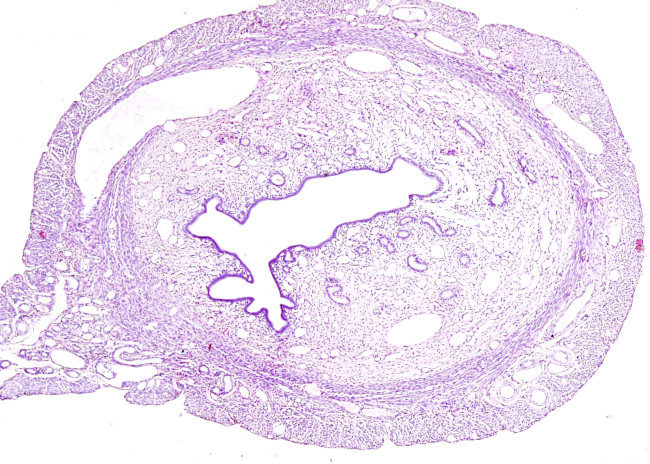
The uterus is a hollow organ with a very thick wall. It is the organ where the embryo develops in mammals, and it undergoes drastic changes during the menstrual cycle. The wall of the uterus consists of a mucous membrane (endometrium), a muscular layer (myometrium), and a serous membrane (perimetrium).
The endometrium, or uterine lining, consists of a layer of simple columnar epithelial tissue and an underlying layer of connective tissue. Numerous glands are embedded within the connective tissue. The cyclical changes in the uterus are most evident in the endometrium, which grows significantly to prepare for implantation of the embryo when there is an increase in estrogen and, subsequently, progesterone. These hormones also cause an increase in mucus secretion by the glands, which become sinuous and sac-like, and an expansion of the vascular network. If the embryo does not implant in the uterine walls, the part of the endometrium known as the functional layer is shed and expelled through the vagina. A portion of the endometrium called the basal layer remains, which will form the lining until the next menstrual cycle. This basal layer is the innermost part of the endometrium, in contact with the myometrium. The shedding of the functional layer exposes connective tissue of the mucosa, which is then covered by epithelial tissue generated by the mucosal glands.
The myometrium consists primarily of smooth muscle and connective tissue and is richly supplied with large-caliber blood vessels, from which branches extend to supply the endometrium. The cells of the endometrium also undergo changes in preparation for pregnancy. The smooth muscle cells undergo hypertrophy, reaching a length of about 500 µm. In addition, new smooth muscle cells are generated through the division of existing cells or by differentiation from mesenchymal cells. Connective tissue also develops through the formation of collagen and elastic fibers during this preparatory period.
In the image of the rat uterus shown above, you can see that there is a circular layer and a longitudinal layer of smooth muscle, between which lies a highly vascularized layer of connective tissue.
The serosa, or perimetrium, is a very thin layer of connective tissue that covers the entire organ.
The most caudal part of the uterus is called the cervix, which connects to the vagina.

