
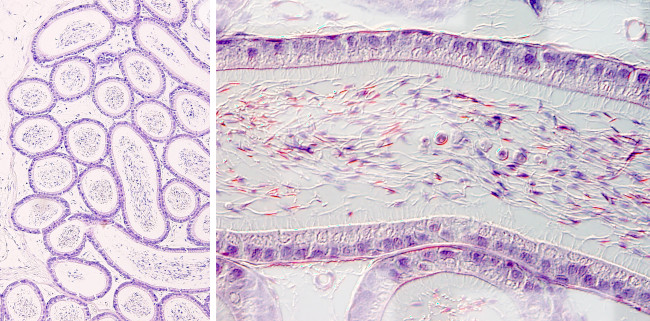
The epididymis is a highly coiled tube that carries sperm from the testicles to the vas deferens, which empties into the urethra. It also serves as a sperm storage site, a function that is particularly important in species with reproductive strategies involving frequent mating over a short period of time. The epididymis is usually enclosed in a layer of tissue called the tunica vaginalis.
The epididymis is divided lengthwise into three regions: the head, the body, and the tail. The head is involved in sperm maturation, while the body and tail keep the sperm in a resting state and serve as a storage site. In humans, the capacity to store sperm in the tail is more limited by their own reproductive strategy. Thus, while rodents have enough sperm for 10 to 12 ejaculations, in humans there is enough for only 2 or 3.
The epididymis begins with the efferent ducts, which collect sperm from the rete testis and transport them to the epididymal tubules in the proximal region; together, these structures form the head region. The efferent ducts are small-diameter, densely packed channels. In humans, they are lined with a thin, ciliated epithelium. The number of efferent ducts connecting the rete testis to the epididymal tubule is small in rodents. The efferent ducts also serve the function of water reabsorption.
The epididymal tubule has a pseudostratified epithelium with stereocilia on its free surface, but these are not ciliated. This epithelium is composed of various cell types connected by junctional complexes, notably tight junctions. The following cell types are distinguished: principal cells, thin cells, clear cells, and basal cells. The thin and clear cells are associated with intense endocytic activity. Basal cells are characteristic of the epididymis and produce prostaglandins (hormones). Additionally, they appear to provide protection against oxidative agents and extend cellular processes that allow them to come into contact with seminal fluid. Finally, they can acquire stem cell functions. They are positive for cytokeratin 5. In the efferent ducts, no basal cells positive for cytokeratin 5 are observed. This is a clear distinction between the efferent ducts and the tubules of the epididymis.
In all species, the epithelium of the epididymal tubule is thicker in the proximal regions of the tubule than in the caudal regions, while the interior of the duct widens from rostral to caudal. The epithelium is surrounded by a basal lamina and connective tissue, beneath which lies a very thin layer of smooth muscle cells that produce peristaltic contractions.
In the epididymis, there may be connective tissue septa that divide the epididymis into proximal and distal segments. There are 10 segments in mice and 19 in rats. In humans, however, the epididymis cannot be divided into these segments. Only one septum is distinguishable, separating the vas deferens from the epididymis.
Bibliography ↷
Bibliography
Sullivan R, Légaré C Lamontagne-Proulx J, Breton S, Soulet D. 2019. Revisiting structure/functions of the human epididymis. Andrology. 7: 748-757.
